


A lot of people talk about "the number" that they want to hit - one million, two million, maybe even ten million dollars. The number seems to me to be tied to the idea that once someone hits "their number" they will feel comfortable letting off the gas and escaping the rat race. Since this is such an important topic, I thought it would be worth putting a little thought around just what it takes to hit those multi-millionaire levels of wealth accumulation.
What's Your Number?
I find that most people don't have a clear idea of how much money they might need to support their current lifestyle, or some higher level of spending that they aspire to. Given that, I thought a great place to start is a quick review of what kind of cash flow you might expect to get from a generic portfolio of various sizes. With that in mind, let's set out a few assumptions from the start.
- Our asset allocation mix will be a simple 75% S&P 500 and 25% Intermediate-Term Government Bonds portfolio.
- Using recent averages from Professor Damodaran's Historic Returns Tracker we will take this to be 11.86% and 4.82% respectively, for our stocks and bonds.
- The weighted average return for our portfolio is assumed to be 10.10%.
- A decumulation period of 30 years is assumed.
- To keep our portfolio from running out of money too fast, an annual safe withdrawal rate of 4% that is adjusted up with inflation every year at a rate of 3% is assumed.
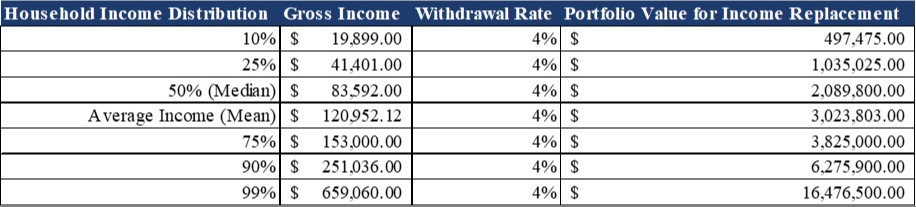
Those assumptions result in the following table.
Note: Data above is historic in nature and does not guarantee any future results. You should not take these, or any assumptions herein, as a recommendation. This information is here for educational purposes and as a way to frame a conceptual understanding of how to approach the concepts we are writing about. Please consult with your financial advisor about what assumptions are appropriate for your personal circumstances.
A simplified 75/25 portfolio, under these assumptions, would need to be about $2 Million to replace the median household income in 2025 for a 30 year period of time. Likewise, to attain purchasing power consistent with a household at the top 10% of the income distribution a portfolio would need to be about $6.26 Million. This begs the question, how long would it take to accumulate that amount of wealth and what would the savings rate need to be to get there?
The Accumulation Phase
Knowing the end goal or your number is a good starting point but it is also helpful to understand what it takes to get there. In the military we called this route planning, in finance we call it retirement planning.
During your accumulation phase you may find it helpful to understand what your target savings rate is in percentage and dollar terms is to achieve your goal given your portfolio's average assumed rate of return. So, let's take the example above as a starting point by extending on the chart to show what our hypothetical portfolio might return given some annual savings rate targets.

What we find in our example given our assumptions is that to accumulate a ~$2 Million portfolio over a 30-year period, a household would have to save just under $13,200 per year. That's about $2,600 per month. If that same household is at the median income distribution point in our example ($83,592) then that savings represents 15.78% of their gross income. You may have noticed that as long as you are targeting replacement income at your household income distribution level, the savings rates for each accumulation period remains the same.
- 20-Years to replacement income: 44.64% savings rate
- 30-Years to replacement income: 15.78% savings rate
- 40-Years to replacement income: 5.96% savings rate
Perhaps this pattern is why rules of thumb, or heuristics, about "how much you should save" are so popular. I can't tell you how many times I have heard someone say, "If you save x% of your income for retirement you'll be fine."
What About the Risks?
While this simple example is reassuring, it ignores many real world factors. For example, it would probably be wise to consider some of these personal factors: How much time someone has left remaining until they retire, what their current savings is, what an appropriate asset allocation for their portfolio might be, health concerns and life expectancy, and what types of tax sheltered accounts their money is in. Then there are the external factors: Current interest rates, inflation, market valuations and growth levels.
It is nice to look at long term averages and make guesses at what might be but when your life's savings is on the line it is worth a more careful look. You would do well to pressure test your financial plan by seeing what a few years of down markets or high inflation might do. Research has indicated that the first decade of market performance post-retirement is critical for your financial success during retirement.
If you have questions about how to plan for retirement or have questions on another topic, schedule a consultation today or contact us to get your questions answered.
Disclaimer: This blog post is intended for educational purposes only; it should not be construed as tax advice or financial planning advice. Consult a professional for tax and financial planning advice before making any changes. All photos are from open-source domains, are ai generated or are the property of Stars & Stripes Financial Advisors.