


There are many career paths military members consider when they are transitioning to a career in the civilian world as a veteran. One industry category in-particular draws the most veterans to it by a wide margin and that is work as a civil servant or government employee in the federal, state or local government. According to the Bureau of Labor Statistics (BLS) data from August 2023, 23.5% of veterans were employed in the government. Perhaps this is not surprising because the same sense of duty and service we enjoyed while serving in the military may be achieved by serving our country in other ways. That is why I started Stars & Stripes Financial Advisors, to continue to serve the community I care about and the country I love.
With the government being by far the largest single employer of veterans, it begs the question; "Is it worth it to pursue a career as a civil servant after the military?"
Let's explore that question.
Stability & Job Security in Government Jobs
It has long been accepted knowledge that a career working for the government comes with a level of stability and job security that is rare in other industries. After all, when your employer is backed by the full faith and credit of the country, state or town you live in it is hard to imagine a lot of situations in which your employer "goes out of business." The idea that the United States of America might cease to exist comes with a lot of assumptions in which you are probably more concerned about where your next meal comes from than if you will be able to keep your job.
Between 2023 and 2024, the total separations in the government averaged between 1.4% and 1.6% compared to 3.6% to 3.8% for the private sector, according to the BLS. So, the data would seem to suggest that there is something to the notion that there is generally more stability in government jobs than there is in the private sector. However, as recent events have made clear, that doesn't necessarily mean that your individual job is secure now or that these averages will continue to hold true going forward.
Pay & Benefits, Education Matters
Often times people will say that the pay and benefits in the government sector are better than they are in the private sector. However, it is actually a bit more complicated than that and depends a lot on what your level of educational attainment is. Let's explore the breakdown of how the pay in the government compares to non-government roles based on educational attainment. Please keep in mind that this data compares federal government roles (including military) to non-government roles. Unfortunately, I could not find enough information for state and local government pay or federal positions without the military to make a good faith comparison that distinguished those roles.
Wages for Federal Employees start out higher at lower levels relative to private sector employees with lower levels of educational attainment but then decrease relative to private sector employees as their educational attainment increases.

Benefits for Federal workers are indeed better across the board. This isn't terribly surprising for anyone who has served. Afterall, there are very few private companies that offer a defined benefit pension these days which is a hallmark of federal service. The insurance provided to government workers is also among the best in the country, in my opinion.

What does this all look like in the context of total compensation? Effectively the total compensation advantage is present for federal workers who have attained a bachelor's degree or less in terms of educational attainment. However, for those federal workers with advanced degrees they actually earn less in total compensation than they would in the private sector on average.

The Congressional Budget Office is the source of this data, and has provided a very clean graph that show the relationship from the above tables.
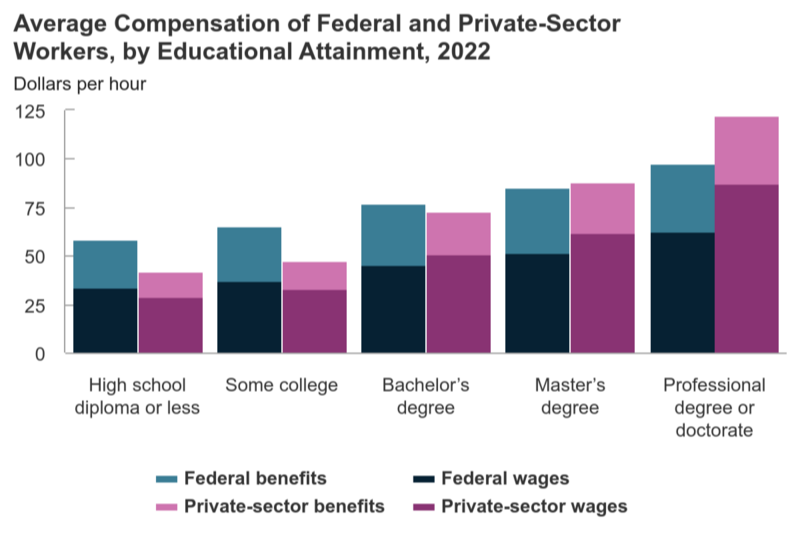
I would encourage you not to have the takeaway here be that you should avoid education because your relative advantage goes away. As you can see in the graph above the average pay goes up in tandem with educational attainment no matter what part of the labor force you land in. The number one factor that influences how much money you earn over your life is your level of educational attainment.
Serving our Country and Having Purpose
It is hard to say how one might put a number on the value of service to a greater good, or having purpose. To people like us who have served our country, it is undeniable that service to our country and purpose does have value. For many of us who identify as service oriented individuals and thrive in environments where we are working towards a mission that is greater than ourselves, we may find a next career as a civil servant or government employee to be deeply enriching and fulfilling on a personal level. I love the quote from A Christmas Carol, "money is but a drop in the bucket of the business of life." The purpose we seek in life outside of the matters of the wallet are often the most important.
Transferability of Skills, Certifications and Security Clearances
There are certain skillsets, certifications or security clearances that you obtain in the military that private sector employee might not understand the value of. Some employers are better at understanding the value of these aspects of your service but it is doubtful you will find as many who truly understand as you do in the government. Afterall, the government as a whole, has a much larger portion of veterans and those veterans likely have a better grasp of the value of your training and experiences.
One of the most valuable pieces of experience to the government is that you already have experience working in the government. It is often the case that government entities are large and filled with complex rules and organizations and none of them are as large as the Department of Defense (DoD). Your ability to navigate that world successfully is an indicator that you may do well in other large government organizations. This provides real value to the teams that are looking to hire and fill their ranks with qualified individuals.
Advantages in the Hiring Process
There is a rule in the federal government called "Veterans' Preference" which helps move certain veterans ahead of other candidates in the hiring process who do not have a preference eligibility. Even among veterans the federal government will distinguish veterans with service-connected disabilities as having a "higher preference". This simply means that their applications get moved to the top of the stack when HR and hiring managers are reviewing candidates for open roles. It does not guarantee a veteran will get the job over other qualified candidates, but it does suggest you veterans will have a greater chance of being looked at for those positions.
Conclusion
It is hard to say whether or not a second career as a civil servant or government employee will be worth it for you after serving in the military. The data suggests that the relative benefit in financial terms is greater for those who have lower levels of traditional education, but it makes sense that the government would recognize the value of the training you received in the military more than a private employer might. However, the data also indicates that the government understands it can pay less to people with advanced degrees. This may be because the personal joy we experience knowing we are continuing to serve our nation and a purpose that is greater than ourselves.
So, as my finance professor would often say, "the answer depends." It depends on your values, your education, your career ambitions and how much your enjoy security and stability in your life. Unfortunately, as in so many other things in life, there is not a clear answer here.
Disclaimer: This blog post is intended for educational purposes only, it should not be construed as tax advice or financial planning advice. Consult a professional for tax and financial planning advice before making any changes. All photos are from open source domains.