


The election is behind us now and as we look forward it is incumbent on us to make the best of our situations personally, as it always is. In that spirit, let's focus our attention on what we expect might happen and why, and how we can take advantage of what we expect to happen.
What is the political ideology and how does that inform the policy that matters?
The first thing anyone should understand about Trump and his political ideology is that it most closely aligns with Neoliberalism. Maybe you are already familiar with neoliberalism but even if you are not you are probably familiar with the ideas associated with it. The ideas associated with neoliberalism are things like small government, low taxes, free-market capitalism (not to be confused with fair-market capitalism), deregulation and hierarchy based social order. In short, neoliberalism put forward the idea that governments should be run like businesses, or monarchies, in which the wealth and power of a nation is consolidated in and for the benefit of the ruling class. This will be an effective guide to keep in mind as we dive into the policies.
What are the policy agenda items we should be thinking about?
TAXES
Tax Rates on Individuals and Businesses
One of Trump's policy victories in his first term was the Tax Cuts and Jobs Act (TCJA) which put into place a more regressive tax system. Another way to put it is that the TCJA gave more tax breaks to rich people than it did to poor people. This is in line with his neoliberalism ideology and is what many policy watchers think will happen again in a second term.
Among the policy points Trump ran on in his candidacy was an extension of some of the tax breaks in the TCJA that are currently set to expire at the end of 2025. Another policy idea he ran on was reducing taxes on businesses even further. The current tax rate on businesses is 21%. The last time our country had a tax rate for businesses lower than 21% was 1939.
Generally speaking, tax breaks on corporations are thought to be good for business owners and the stock market but bad for the federal budget. Effectively a reduction in the tax rates of businesses will mean the government either has to reduce spending or tolerate a larger deficit. Businesses on the other hand will have plenty decisions to make of how to spend that extra cash it no longer needs to send to the government. Among the options are investing in capital goods, higher pay to employees and management, or more generous dividends and buybacks.
Tax cuts on businesses and high income households should be good for the financial commandos out there with high incomes who invest in the stock market or own a business. However, to the extent that these cuts require the federal government to cut spending, these tax cuts will likely result in fewer federal jobs and contracts, a higher budget deficit and less more for social programs that keep the elderly, poor and sick out of poverty.
Tariffs (also a type of tax) on Goods
Tariffs, like tax cuts, were a big part of Trump's first term in office. In the world of economics tariffs are referred to as excise taxes. When our country was first starting out the only type of taxes we had were excise taxes and they were quite popular back in the 1700's. Boston Tea Party anyone?! That historic event was prompted by the excise taxes the British imposed on the colonies which later became the U.S.A. You can imagine a modern day version of that occurring around the world in retaliation to U.S. tariffs levied against other countries. During Trump's first term in office China specifically targeted U.S. agriculture and manufacturing which simultaneously hurt our industries and bolstered China's industries.
It wasn't until 1913 with the establishment of the 16th Amendment to the Constitution that Congress was granted the power to tax businesses and individuals. Taxation through tariffs is primarily paid by working class families. In contrast, the progressive tax system currently in place, which levies taxes on businesses and individuals, attempts to have those who benefit the most from our society pay for it in proportion to the benefit they derive from it. In other words, the more value a person or business derives from the economy the more they are expected to contribute back to making sure the economy functions well.
The Trump Tariffs are expected by economists to reduce our real GDP between 0.64% and 2.34% if other countries retaliate, as expected.
Overall, the impact of a reduction in the tax rates on businesses and wealthy individuals and an increase in taxes through tariffs will result in working class families shouldering more of the burden to pay for government expenditures, and reduce the overall wealth and income of the nation.
DEPORTATION
Perhaps one of the most alarming policy ideas coming from Trump is his plan to conduct a mass deportation of immigrants living in the United States. While there is much to be said about the social impacts of this policy, I will focus on the economic impact of this policy.
The first problem with this policy is that it is going to cost the country a lot of money. The idea behind the policy being floated of this mass deportation is anyone who is an immigrant as opposed to the executive action that President Obama took in 2014 to prioritize illegal immigrants, gang members, convicted felons, and those with multiple misdemeanors over other immigrants. Effectively Trump's policy would no longer distinguish one immigrant from another on the basis of their threat or detriment to society thus enabling a deportation in mass. Estimates of what this might cost is roughly $50.3 billion dollars according to the Center for American Progress (CAP).
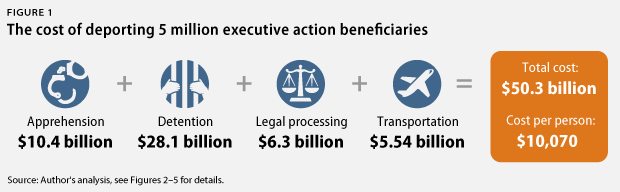
Source: Center for American Progress
However, this analysis overlooks the economic benefits of immigrants who are working peacefully within the United States and are paying their taxes as most of them are. Estimates from the Center for American Progress indicate that immigrants that would no longer be protected from deportation over a five year period account for $22.6 million dollars in income tax revenue, and over a ten year period contribute $41 billion dollars to Social Security and $210 billion dollars to GDP. The combined impact of the mass deportation efforts would result in a higher deficit and a less solvent Social Security as a result of this group also being targeted for deportation.
Finally, by deporting a large portion of the U.S. workforce the labor market may tighten again. This can result in higher wages as employers attempt to attract people to jobs they otherwise wouldn't fil. On the downside that also means companies will have to raise their prices to compensate for the increased cost of labor which of course increases the chances of more inflation. If inflation gets too hot and the Federal Reserve remains independent then we can expect that interest rates will once again rise making housing, vehicles and anything else purchased on credit more expensive.
WHAT THIS MIGHT MEAN FOR YOU
Much, if not all, of these proposed changes are far outside of our control to influence them. What's more is we must take on these new policy ideas with a sense of humility. Afterall, we do not know which policies will actually be enacted and to what extent. Furthermore, there are plenty of forces outside of the political sphere that influence our economy or are not within the control of the executive branch of government. For example, if we see a wider war in the Middle East or if the war in Ukraine spills over into Easter Europe our entire economic and global paradigm might shift overnight.
Often the wisest course of action is to prepare for the worst and hope for the best.
If Trump's policy positions are executed as articulated while he was campaigning and no unforeseen factors change the economic landscape then we might expect something akin to the stagflation of the 1970's. Stagflation is a phenomenon in economics in which inflation is high and growth is low. This bucks the usual observation in which high inflation accompanies strong growth as we have seen the past few years.
Looking at the last bout of stagflation (1973 - 1982) we see that the asset classes that beat inflation on average were Gold and Real Estate. However, Real Estate did it without as much stomach ache. The other asset classes simply did not keep up with inflation even if some did have much lower standard deviations, cash being the prime example.

But what if we are wrong only slightly and we are instead headed for a low growth phase accompanied by moderate to low inflation like we saw in the time period immediately after stagflation? If that is the case, we might expect Gold to be the worst performing asset class. Real Estate performed well during that period but nowhere near as well as the equity and bond markets did which returned vastly bettern than they did the decade prior.

The reality is that when we are making decisions about what asset classes to invest in we are fighting an uphill battle against uncertainty and chance. That is one reason that i often caution people not to make drastic decisions when it comes to their investment mix.
One final note about the equity markets in the U.S., the current valuation levels are very high for the S&P 500. To support these high valuation levels you have to make some heroic assumptions about earnings growth going forward which might be undermined by Trump's policy agenda. If you compare the 1970' and 1980's valuation levels to today's valuation levels you can see a stark difference. Some of that difference might be explained by the much higher business tax rate of between 46% and 48% during that time frame. The current business tax rate is 21%, or less than half of what it was during the 70's and 80's. However, if we look at the 1920' and 1930's (the last time business tax rates were this low) we see valuation metrics that are much lower generally hovering between an earnings multiple of 10 and 25. With this in mind, I wouldn't be surprised if we experience a correction in the equity markets. Unfortunately, and as usual, guessing when that might occur is beyond my sight.

Source: https://www.multpl.com/s-p-500-pe-ratio
There are two asset classes that I want to draw your attention to because they can provide you some peace of mind in these uncertain times.
First is cash. Here and in the charts above when I refer to cash I am speaking about the 3-month U.S. Treasury Bill rate. You will often find this rate available to you in your high yield savings accounts or via certificates of deposit. Cash and cash equivalents provide us with the liquidity we need to make changes in a hurry. Most people will find that if they have enough cash on hand they feel they are better prepared for what may come their way. This can help ease any uncertainty or doubt you may have about the future. If you are feeling that anxiety then I would ask you to reconsider how much of a cash store you keep on hand.
Second is U.S. Housing. U.S. Housing as I am writing about it here is the home price index that Case Shiller tracks. Effectively it is the change housing prices on average across the country. In both of the periods presented above housing price performed mediocre but had no negative years of return and a low level of variability which is reflected in its standard deviation, just as cash did. This stability within your financial life can be a source of reassurance as well even if it is not as liquid as cash is.
One other point to call out about the nature of your personal home is that while the price of your home will likely appreciate with inflation, the mortgage you took out on it will depreciate relative to your earnings power as you are awarded with cost of living adjustments and raises. This growing gap between your income and your mortgage payment can generate a dramatic increase in extra free cash flow and wealth over time. Typically a person's home is their largest expense and freezing that price in time can be very beneficial. Do not underestimate the value of home ownership during periods of moderate to high inflation.
Finally, I will urge all of you that are in the government currently, or on contracts for government work, to be extra vigilant. The cuts to the federal budget that are being proposed are so drastic that it can hardly be assumed that it will not result in fewer government jobs and contracts in total. If this applies to you, you would be wise to start considering increasing your cash reserves and preparing for a competitive job market. Being unemployed for long periods of time can wreck a person's financial life. There is nothing like widespread layoffs to ruin your day.
Disclaimer: This blog post is intended for educational purposes only, it should not be construed as tax advice or financial planning advice. Consult a professional for tax and financial planning advice before making any changes. All photos are from open source domains.